
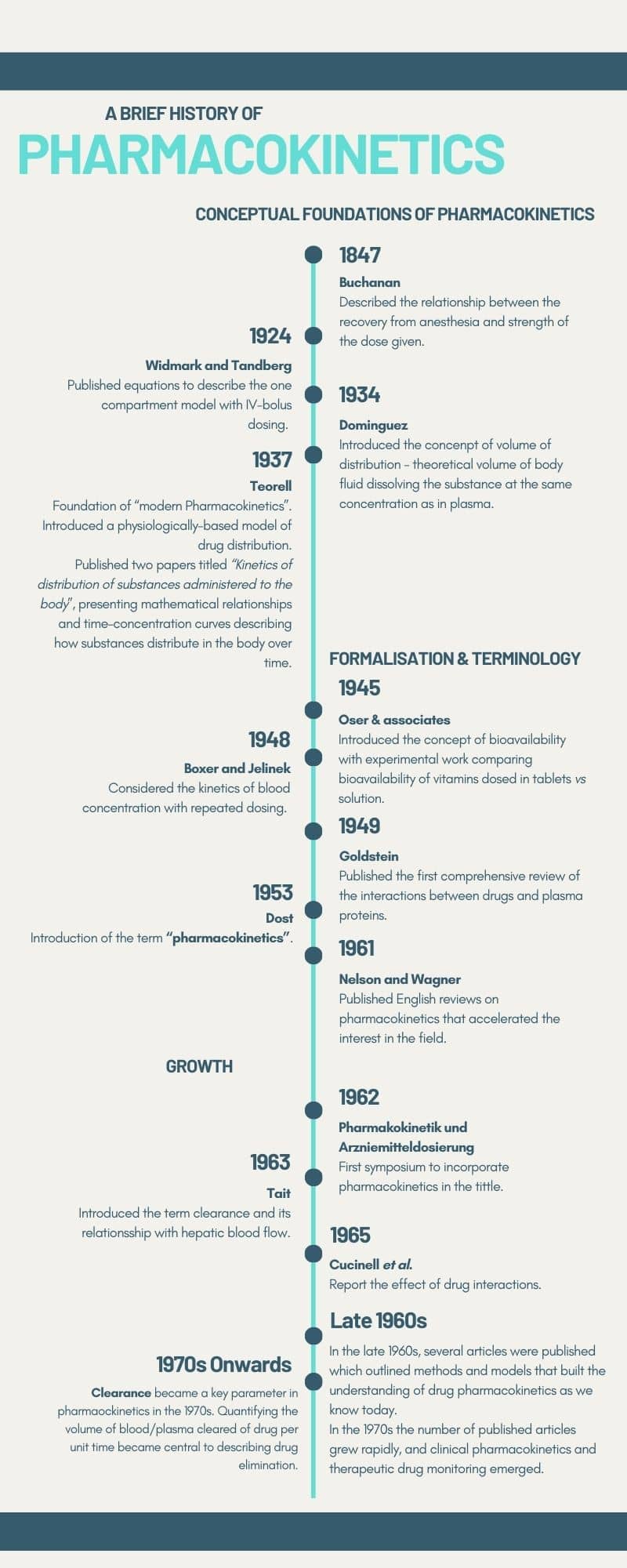
Pharmacokinetics (PK) seeks to provide a mathematical understanding of the blood concentration/time-course of an administered compound or drug. PK is part of a broader topic which aims to understand the quantitative processes of absorption, metabolism, distribution and elimination (ADME). Although the term “pharmacokinetics” was introduced in the 1950s, the foundations and concepts were described much earlier 1,2,3,4.
Join us on a journey from the origins of pharmacokinetics, through its introduction into drug discovery and the evolution of its role over time.
The Concepts and Roots of Pharmacokinetics:
Our story begins in the early to mid 1920s, a period recognised as the birth of modern pharmacokinetics by the contribution of Torsten Teorell5,6, who helped frame the conceptual basis of the field, alongside the introduction of the first mathematical models of IV bolus dosing by Widmark and Tandberg7.
Formalisation and Terminology:
The journey continues in the 1940s-60s where the term “pharmacokinetics” was introduced by F.H. Dost in his book: Der Blutspiegel8, which helped the discipline to gain significant traction.
By the 1960s, compartmental modelling (one-compartment, two-compartment, etc.) became common, and mathematical/curve-fitting methods were developed to describe drug concentration over time in blood/plasma or tissues. During this period, PK started to be seen not only as an academic curiosity, but as essential for guiding safe and effective dosing, explaining inter-individual variability, and predicting drug behaviour under different physiological conditions1,3,4.
Growth:
In the decades that followed, PK became a core scientific discipline. Its presence grew in drug research and clinical medicine through the concept of therapeutic drug monitoring (TDM)*, with studies and practices emerging to adjust drug dosages based on measured concentration.
By the early 1980s pharmacokinetics (what the body does to the drug) began to be linked with pharmacodynamics (what the drug does to the body). Both were captured under the broader term of quantitative pharmacology with the key parameters of concentration, time and effect. At the same time, researchers built on the understanding of variability across populations, studying how factors such as gender, life habits, genetic and metabolic differences and disease states influenced therapeutic regimens1,3,4.
Modern PK: Advanced Modelling and the Rise of PBPK
As computing power improved, more sophisticated tools, such as Physiologically Based Pharmacokinetic (PBPK) models have become popular. PBPK uses information about the properties of a drug alongside knowledge of anatomy and physiology to mathematically simulate the concentration of drug across the body over time1.
Although the conceptual roots of PBPK trace back to Teorell’s work in the 1930s, its practical application flourished only once computational tools, and physiologic datasets became robust enough.
* TDM is the clinical practice of measuring specific drugs at designated intervals to maintain a constant concentration in a patient’s bloodstream, thereby optimising individual dosage regimens9.
The Impact Today
Over the decades, the field of PK has grown steadily more advanced, driven by developments in bioanalytical instrumentation, computational modelling and knowledge of physiology. Today, it sits at the heart of modern pharmacology, drug development, and personalised medicine.
It is essential to note that being able to predict the human blood (and therefore unbound plasma) PK concentration/time-profile is just as important from an efficacy perspective as it is to understand and mitigate against unwanted pharmacological and ultimately toxic effects.
The study of pharmacokinetics has been shaped by the contributions of many researchers over the decades. Whilst we cannot mention all of them here, we’ve included additional references for those readers interested in exploring the history of pharmacokinetics in greater depth.
References:
- JOHN G. WAGNER 1981, History of Pharmacokinetics. Pharmac, Ther. Vol 12: 537-562. https://doi.org/10.1016/0163-7258(81)90097-8
- OS Michael 2015, FIRST REPORTS OF CLINICAL PHARMACOKINETICS IN NIGERIA. Ann Ib Postgrad Med 2015 Jun;13(1):48–53. https://pubmed.ncbi.nlm.nih.gov/26807087/
- Lennart K. Paalzow 1995, Torsten Teorell, the Father of Pharmacokinetics. Upsala J Med Sci 100: 41-46. https://doi.org/10.3109/03009739509178895
- PAUL J. WILLIAMS and ENE I. ETTE. Pharmacometrics: The Science of Quantitative Pharmacology, chapter: Pharmacometrics: Impacting Drug Development and Pharmacotherapy. DOI:10.1002/0470087978
- T. 1937a, Kinetics of distribution of substances administered to the body I. The extravascular modes of administration. Archs. int. Pharmacodyn. Ther. 57:205 255.
- T. 1937b, Kinetics of distribution of substances administered to the body II. The intravascular modes of administration. Archs. int. Pharmacodyn. Ther. 57: 226-240.
- E. and TANDBERG. J.1924, Uber die bedingungen fur die Akkumulation Indifferenter Narkoliken Theoretische Bereckerunger.) Biochem. Z. 147: 358-369.
- DOST, F. H. (1953) Der BliitspiegeI-Kinetic der Konzentrationsablaiife in der KrieslaufJ~ssigkeit. G. Thieme, Leipzig, p. 244.
- Ju-Seop Kang 2009, Overview of Therapeutic Drug Monitoring. Korean J Intern Med. 2009 Mar 6;24(1):1–10. https://doi.org/10.3904/kjim.2009.24.1.1