
Often, when working with our clients we are presented with projects where the clearance studied utilising in vitro liver systems (intrinsic clearance (CLint) determined using liver fractions like microsomes or hepatocytes) does not predict the systemic clearance observed in vivo when using the well-stirred liver model
Our aim at DDS is to help projects’ understanding of the predominant in vivo clearance mechanism, and to ensure that selection criteria is optimised on the parameters that are relevant to the systemic clearance of the compounds.
The use of classification systems like the “Extended Clearance Classification System” (ECCS)1, allow us, early on, to predict the likely predominant clearance mechanism (rate-determining process) based on the physicochemical and passive permeability properties of the compounds, and then, tailor the screening cascade based on those predictions.
Although there are several classification systems published that aim to improve, simplify, and speed drug development, the simplicity of the ECCS model, alongside the fact that physicochemical properties of compounds are all that are required to utilise this method, makes it the tool of choice when predicting clearance pathways for new chemical series.
In this article we will explore the main characteristics of this model and how we can use it day-to-day with projects to tailor their screening cascades to their compound’s properties.
The Extended Clearance Classification System (ECCS), introduced by Varma et al., 2015 relies on clearance concepts.
The main purpose of the ECCS is to predict the predominant clearance mechanism based on physicochemical properties (e.g. molecular weight (MW), ionisation state) and passive membrane permeability.
According to the ECCS the compounds are classified in one of six classes based on ionisation, molecular weight and cell permeability (Figure 1).
With cut-off values:
A permeability cut off value of 5×10⁻⁶ cm/s using MDCKII-LE2 is applied to define high and low permeability classes which allows the model to distinguish between high and low intestinal absorption (Fa) and renal clearance with high sensitivity and specificity.
The MW cut off value of 400 Da enables the distinction within the acids and zwitterions group between Organic-Anion-Transporting Polypeptide (OATP) substrates (Classes 1B and 3B) and non-substrates (Classes 1A and 3A).
The six classes are defined as follows1.

Class 1A
The main mechanism of clearance for compounds in this category is hepatic metabolism, and neither uptake nor efflux transporters are expected to affect their systemic clearance. Compounds in this class are mainly metabolised by Cytochrome P450 (CYP) enzymes, but other Phase 2 pathways such as glucuronidation could also be relevant.
The main in vitro tools useful to predict human clearance that should be included in the screening cascade for class 1A compounds include human liver microsomes (HLM), hepatocytes and human UDP-glucuronosyltransferases (UGTs).
Class 1B
After being cleared from blood by the OATP transporter family (active uptake), this class of compounds are expected to undergo
metabolism in the liver (mainly by CYP3A4/2C and UGT enzymes) and are then excreted into bile or urine by active transport.
In this case clearance should be predicted using a hepatocyte uptake assay or sandwich culture human hepatocytes as standard HLM or hepatocyte CLint assays will underestimate systemic clearance.
Class 2
Due to their characteristic high permeability, class 2 compounds can cross the basolateral membrane of the hepatocytes via passive diffusion before being metabolised and excreted into the urine/bile as phase I or II metabolites.
Similarly to class 1A, the in vitro tools of choice to predict human clearance for this group of compounds are HLM, human hepatocytes or other human in vitro systems aligned with the underlying metabolic process.
Class 3A
Compounds in this group are predominantly eliminated renally as unchanged drug, and it is possible that renal transporters Organic Anion
Transporters 1 and 3 (OAT1, OAT3) can play a role in their elimination.
In this case, no simple in vitro tools are typically available to predict in vivo clearance, and so, physiologically based pharmacokinetic models (PBPK) or single species allometric scaling would be required to predict human in vivo clearance.
Class 3B
Class 3B compounds are generally cleared by either hepatic active uptake or renal clearance and eliminated as unchanged drug in bile or
urine. Hepatic (OATPs) and renal (OATs) uptake transporters are key in the clearance of compounds in the class 3B group. It is their specificity between OATPs and OATs that determines if the compound will be mainly cleared renally or biliary.
In vitro metabolic experiments will underestimate the clearance of these compounds and in vitro hepatic uptake studies will be
required. For the compounds cleared renally, the same approach as class 3A will be required.
Class 4
Finally, compounds in the class 4 group are predominantly cleared by glomerular filtration and transporters such as Organic Cation
Transporter 2 (OCT2) and OAT family are key in active renal secretion. Again, as discussed for class 3A and renally cleared compounds in class 3B human clearance can only be predicted by PBPK models or using single species scaling.
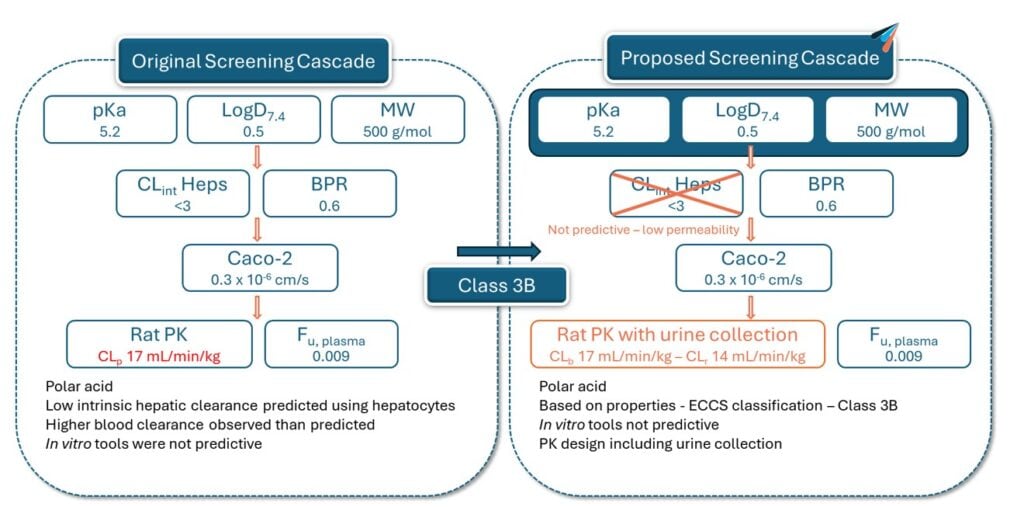
Using this classification system allows us to help projects determine which in vitro or in vivo tools would be best placed for their project to be able to predict how their compounds will be eliminated in vivo (Figure 2).
Drug Discovery Solutions is a DMPK consultancy company based in Loughborough, UK. We offer DMPK support to a range of clients including data review, PK modelling and simulation and human PK parameter and dose prediction to projects at various stages of the drug discovery. If you need any advice as to how to modify your screening cascade so it is more tailored for your project compounds, please get it touch here.
References
(1) Varma MV 2015, Predicting Clearance Mechanism in Drug Discovery: Extended Clearance Classification System (ECCS), Pharm Res, vol. 32, pp. 3785–3802, DOI: 10.1007/s11095-015-1749-4
(2) Varma MV 2012, pH-Dependent solubility and permeability criteria for provisional biopharmaceutics classification (BCS and BDDCS) in early drug discovery. Mol Pharm. vol. 9/issue 5, pp. 1199–212. DOI: 10.1021/mp2004912